
When Animals Help Heal the Father Wound

Updated: Aug 23
Our pets are the first to sense what we've spent a lifetime learning not to feel.
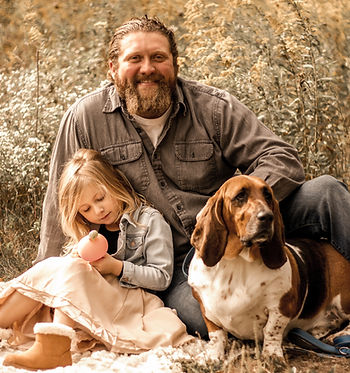
Whether we grew up with a father present or absent, emotionally available or not, all children carry the same fundamental need: to experience the healthy masculine.
In today's world, masculinity is still portrayed as dominance or performance. But the masculine as it is meant to be is more like this: protective without being controlling, encouraging without being conditional, a steady reliable presence without being cold. A presence that says: the world is safe enough for you to grow. I see you. I believe in you. And I support you, I got your back.
What happens when that quality of masculine presence is missing — or was there but filtered through its own wounding?
For girls, the absence of healthy masculine presence makes it difficult to fully inhabit their own feminine nature. When a girl doesn't receive protection, encouragement, and safe witnessing from a grounded male figure, she receives an unconscious message that her softness, her feeling, her receptivity — her femaleness — is not safe in the world. So, she learns to armour it. To lead with competence rather than vulnerability. To manage rather than receive. To achieve in order to feel worthy, rather than simply be and feel held.
She may find it hard to trust, to receive support, to let herself be seen in her full emotional depth, because no one with a healthy masculine presence ever showed her that this was safe. The feminine, left unprotected and unwitnessed, learns to hide.
For boys, the wound cuts differently. A boy needs a male role model not simply to learn how to do things, but to learn how to be. He needs to see healthy emotion modelled, like in a man who can hold both strength and tenderness, who shows that vulnerability doesn't collapse you, who demonstrates that anger can move without destroying. Without that mirror, boys are left to construct their own version of manhood and that might just lead them to borrow from cultural scripts that teach suppression, performance, and emotional isolation.
The boy who never saw his father grieve, soften, or ask for help grows into a man who doesn't know that he's allowed to. And the wound perpetuates itself — because wounded masculinity cannot offer what it never received.
Both paths lead to the same hidden ache: the longing to have been met by someone who could hold all of who we are.
A story of being seen
When Claire first reached out to me, it was about her dog, Juno. Juno had become restless, unable to settle unless Claire was within sight, growing anxious every time Claire left the room.
Claire was in a demanding season of life. She'd built a successful career in a male dominant segment, largely on her own. She was proud of how capable she was and how tough, and jokingly told me that her work colleagues called her "the colonel".
As we explored her bond with Juno, something tender surfaced. Claire's father had been a good provider but emotionally distant — present at the table, absent in every way that mattered to a small girl who simply wanted to be delighted in. She'd learned early that being impressive earned attention, but being vulnerable earned nothing. So she stopped being vulnerable. With everyone.
Except, it turned out, with Juno.
"She's the only one who sees me when I'm not performing," Claire said. "And lately it's like she can't relax until I do."
Claire realised that this was a turning point and that her dog was the first to say: something is asking to be felt.
It was about time her nervous system learned a new way of being.
When animals offer what the father couldn't
Animals cannot replace the father we needed. But they can offer something remarkably close to the quality we longed for. By now you probably know, it's the unconditional, steady witnessing that neither demands performance nor withdraws when we feel too much.
A dog who greets you as though your return is the best thing that has ever happened. This, for many people, is the first experience of consistent welcome they have ever known. An animal who leans into you when you weep or stays at your side when the world feels too large or follows you from room to room simply because your presence matters to them — this is, in its own way, a form of protection.
Not the protection of control. The protection of presence.
The deeper transformation: who acts when you stop reacting?
Healing the father wound is not primarily a heart transformation — though the heart opens in the process. At its deepest level, it is a transformation of your inner authority.
Who are you when you stop being reactive? Who acts when you are no longer driven by the old survival strategies — the hypervigilance, the controlling, the careful management of how you're perceived? When the armour that once kept you safe begins to feel too heavy to carry?
This is the territory many people find themselves in as the father wound begins to heal. The old mechanisms lose their grip. The strategies that were once genuinely protective — the self-sufficiency, the distrust, the tactical reading of every room — begin to soften. And in that softening, something unfamiliar emerges:
A different quality of strength.
The inner masculine — that capacity for self-directed action, for authority that comes from within rather than being performed for others — begins to reform. For women, this often means discovering they can take up space, make decisions, and act from their own centre without needing external permission or approval. For men, it often means learning to act from groundedness rather than reactivity and to lead from presence rather than defence.
This is subtle and significant work. Because the old pattern felt like power. The vigilance, the control, the always-knowing — even when it was exhausting. Letting it go can feel, at first, like losing ground. Like becoming exposed. And this is often exactly where animals become such valuable companions on the path, because they don't respond to the controlled version of us. They never did. They respond to the one underneath who is learning to act from something truer.
Walking the healing path together
If your animal seems to be responding to something or if you notice your bond shifting as you do deeper work on yourself — you're not imagining it. These connections are not accidental. They are, in the truest sense, sacred.
When we tend to the father wound, we don't just heal ourselves. We free our animals from holding what we've been hiding in our shadows. We step together into a field of greater consciousness and emotional availability.
And perhaps, in doing so, we begin to offer the next generation something different — a new kind of masculine presence. One that protects without controlling. That encourages without conditions. That says, simply and fully: you are welcome here, exactly as you are.
With warmth and possibility,
Fabienne ♡
When Animals Help Heal the Father Wound. Our pets are the first to sense what we've spent a lifetime learning not to feel.
Frequently Asked Questions About Healing the Father Wound with Animals
What is the father wound?
The father wound is the emotional imprint left when we didn't receive the protection, encouragement, or steady presence we needed from a father or masculine figure. It can form whether a father was absent or present, and it often shapes how we relate to trust, authority, vulnerability, and our own sense of worth in adulthood.
What does trauma healing for animals look like?
Trauma healing in animals often looks quieter than people expect. It may show up as deeper sleep, less vigilance, faster recovery after stress, softer body language, more play, and a greater ability to settle. Real healing is often gradual, as the animal’s body no longer has to stay on such high alert.
Can you have a father wound even if your father was present?
Yes. The father wound isn't only about absence. A father can be physically present yet emotionally distant — a good provider who was unable to offer attunement, delight, or emotional safety. Many people carry a father wound precisely because closeness felt conditional on performance rather than freely given.
How does the father wound show up in women?
In women, the father wound often makes it harder to feel safe in their own feminine nature. Without protection and safe witnessing from a healthy masculine presence, softness and receptivity can come to feel unsafe. This may show up as over-functioning, difficulty trusting or receiving support, and leading with competence rather than vulnerability.
How can my animal help me heal the father wound?
Animals offer something close to what many of us longed for: steady, unconditional presence that doesn't demand performance or withdraw when we feel too much. They respond to what's underneath our armour rather than to the controlled version of us, which can gently invite the nervous system to soften and learn a new sense of safety.
Why does my animal seem to react when I'm doing deeper emotional work?
Animals are highly attuned to our nervous systems. When we begin healing, our internal state shifts, and they often sense it before we can name it. Restlessness, clinginess, or changes in their behaviour can be their way of responding to what is moving in us — and these patterns often settle as we become steadier within ourselves.

Free for a limited time — click here to join.
The information provided on this site is for informational purposes only. The products mentioned are not intended to diagnose, treat, cure, or prevent any diseases. The statements on this website/blog/shop have not been evaluated by any Swiss or international authorization and supervisory authority for drugs and medical products.
Do not use herbal products on children, or if you are nursing, pregnant, taking medications, or undergoing treatment for any medical condition, without first consulting a healthcare professional.


